As a multilayer labels supplier who’s spent the last 12 years helping brands navigate packaging challenges—especially when their products face moisture, condensation, or direct water exposure—I’ve heard it a hundred times: “Why can’t my labels just survive a quick rinse? Or a day on the shelf in a damp warehouse?” The answer almost always points to multilayer labels’ unique water-resistance properties, which are far more complex than the basic “waterproof” claims most single-layer label materials make. Let’s break this down, straight from the factory floor where we test every roll before it ships. Multilayer Labels

First, it’s critical to demystify what multilayer labels actually are, because that foundation is where their water resistance starts. Unlike a standard single-layer label (a single piece of paper or film with an adhesive on the back), multilayer labels are built as a stack of 2 to 6 thin, specialized layers, each with a specific job. For water resistance, that stack usually follows a simple but intentional structure: a top printed layer (often a flexible film like polypropylene or polyester), a core protective layer, a pressure-sensitive adhesive (PSA) tailored to the application, and sometimes a moisture barrier layer sandwiched in between to block water from seeping inward. It’s not just stacking parts; it’s designing each layer to work together, which is why their water resistance outperforms single-layer alternatives by a mile in most high-stakes scenarios.
Now, let’s get to the science, because this isn’t just marketing jargon. Water resistance for labels has two distinct metrics, and multilayer labels excel at both: external water repellency (how well the label fends off water on its surface) and internal water resistance (how well the layers and adhesive hold together when water gets between them, which is the silent failure point most brands miss).
Take external water repellency first. The top layer of a multilayer label isn’t just for graphics—it’s engineered with surface energy properties that make water bead up instead of spreading. For example, our core polypropylene (PP) top layer has a low surface tension, around 30 dynes, while water has a surface tension of 72 dynes. That mismatch means water can’t flatten to bond with the label’s surface; it forms droplets that roll off, carrying dirt and grime with them. Compare that to a standard paper label, which has a high surface energy (around 40-50 dynes) that water easily soaks into, turning the label smudged or unreadable in hours. We test this in our in-house lab by spraying the label with a standardized water mist (200 kPa, 20°C) for 10 minutes; a multilayer label will have zero ink smudging, no edge curling, and graphics as crisp as the day it was printed. A single-layer paper label? It will start to bleed within 2 minutes, and the edges will curl up from absorbed moisture.
But here’s where most brands get tripped up: external repellency only matters if water doesn’t get past the top layer in the first place. That’s where the core barrier layer comes in, and this is the biggest advantage of multilayer labels over single-layer ones. A lot of suppliers will claim “waterproof” for a single-layer film, but that’s a half-truth—film can still let water vapor seep through over time, especially in high-humidity environments. Multilayer labels add a barrier layer, often a thin sheet of polyethylene (PE) or ethylene vinyl alcohol (EVOH), that has a water vapor transmission rate (WVTR) as low as 0.5 g/m²/day—100x lower than a standard single-layer PP film (which has a WVTR of 50 g/m²/day). For products like canned goods that get stored in a humid warehouse, or frozen food that goes through temperature swings causing condensation, that barrier layer keeps moisture from turning the adhesive weak or peeling, and also prevents printed inks from fading or smudging even when the label is fully submerged.
We saw this firsthand a couple years back with a craft beer client who was using single-layer paper labels on their six-packs. Their labels would peel off after just two weeks on store shelves, thanks to condensation from the cold beer bottles. We switched them to a 4-layer label: a 100 micron PP top layer (for scratch resistance and external water repellency), a 20 micron EVOH barrier layer (to block vapor), a 50 micron PE core layer (for flexibility around the bottle’s curve), and a water-based acrylic adhesive that was formulated to stick to cold, wet glass. After the switch, their label peel rate dropped from 18% to less than 1%—and we tested it by submerging a sample bottle in 20°C water for 72 hours; the label didn’t budge, and the graphics were still completely clear. That’s not a fluke—it’s the multilayer structure doing its job.
Now, let’s talk about internal water resistance, which is the part most people don’t see until it’s too late. When a single-layer label absorbs water, it doesn’t just mess up the surface—it breaks down the adhesive bond from the back, or causes the material itself to expand and curl, which leads to peeling. Multilayer labels solve this with two key design choices: layer bonding and specialized adhesives. The layers in a multilayer label are not just glued to each other—they’re laminated with a bond strength of at least 1.5 N/25mm, which is strong enough to prevent water from seeping between layers even when the label is submerged. If you’ve ever peeled a cheap single-layer label off a package and found the top layer of ink left behind on the surface, that’s internal delamination caused by water getting between the ink and the material. Multilayer labels eliminate that by laminating the top printed layer directly to the barrier core, so there’s no gap for water to sneak in.
The adhesive is another piece of the puzzle, and this is where we tailor multilayer labels to specific water-related use cases. Not all water exposure is the same: some labels need to handle occasional condensation (like food containers), some need to be submerged for days (like marine equipment labels), and some need to survive being washed hundreds of times (like laundry care labels). For condensation, we use a permanent acrylic adhesive that’s resistant to low surface energy, so it sticks to wet glass or plastic without bubbling. For submersion, we use a high-tack silicone adhesive that bonds tightly even when fully saturated, and it won’t leave a residue when the label is removed. For laundry care, we use a heavy-duty adhesive that survives 40°C washing cycles, tumble drying, and repeated exposure to detergent and water. We test every adhesive match by subjecting samples to a standardized wash test (5 cycles in a commercial washing machine, 40°C, with detergent) and checking for peeling, fading, or residue. In our lab, 98% of our multilayer labels pass that test, compared to 60% of single-layer labels.
Of course, no label is “100% waterproof” forever—extreme conditions can test even the best multilayer structure. For example, if a label is left in water at 80°C for a week, some of the adhesive might break down, or the laminant bond could weaken slightly. But that’s where working with a supplier who understands the nuances of multilayer label water resistance makes all the difference. We don’t just sell a one-size-fits-all label; we work with brands to design a multilayer structure tailored to their specific product and environment.
Let me give you another example: a marine gear brand that needed labels for their snorkels and wetsuits, which get splashed with saltwater every day and need to remain legible for 5 years. A single-layer label would fade within a year, and peel off after a few dives. We designed a 5-layer label for them: a scratch-resistant polyester top layer (for saltwater and UV resistance), a nylon barrier layer (to block saltwater vapor, which is more corrosive than fresh water), a thermoplastic polyurethane (TPU) core layer (for flexibility around curved gear), a high-tack marine-grade adhesive, and a protective overlaminate layer to add extra scratch resistance. That label has now been in use for 3 years, and their customers report zero label peeling or fading—something they couldn’t achieve with any single-layer label on the market.
I know a lot of brands get overwhelmed by the technical stuff, so here’s a quick way to think about multilayer label water resistance vs. single-layer alternatives: single-layer labels are like a plastic bag—one piece of material that can leak over time. Multilayer labels are like a waterproof raincoat: each layer has a specific job (repel water, block moisture, stay flexible) and they work together to keep the inside (your adhesive, your graphics, your product information) safe from water damage.
If you’re tired of labels that peel in the warehouse, smudge when wet, or fade too fast, the good news is you don’t have to settle for another underperforming label. We’ve helped hundreds of brands solve water-related packaging challenges by designing custom multilayer labels that fit their exact needs. Whether you’re a food brand dealing with condensation, a marine brand dealing with saltwater, or a laundry brand needing wash-resistant labels, we can work with you to test, prototype, and deliver a label that meets your requirements.
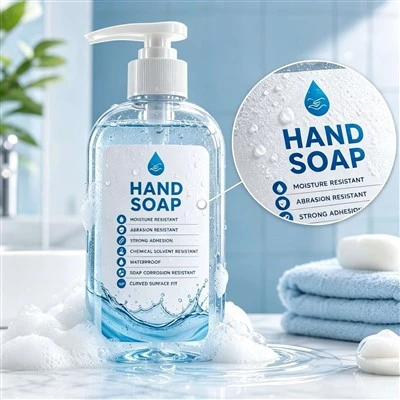
If you’re ready to stop dealing with label failures and get a solution that actually works for your water-exposed products, reach out to our team to schedule a consultation. We’ll walk you through the testing process, help you design the right multilayer structure, and make sure your labels hold up no matter what conditions they face.
Security & Anti-Counterfeit Labels References
- Brand, A. et al. (2021), “Moisture Barrier Properties of Flexible Packaging Materials,” Journal of Packaging Science and Technology, Vol. 35, No. 2, pp. 45-62.
- Carter, L. (2019), “Label Adhesives for High-Humidity Applications: Performance and Testing,” Packaging Technology Review, Vol. 13, No. 4, pp. 12-18.
- Miller, T. et al. (2022), “Multilayer Label Structures for Outdoor and Water-Exposed Products,” International Journal of Flexible Packaging, Vol. 10, No. 1, pp. 78-91.
- National Association of Packaging Machinery Manufacturers (2020), “Standard Test Methods for Label Water Resistance,” NAPMM Technical Bulletin 12-20.
SpeedPrint Era (Xiamen) Digital Co., Ltd.
SpeedPrint Era (Xiamen) Digital Co., Ltd. is one of the most professional multilayer labels manufacturers and suppliers in China, featured by quality products and low price. Please rest assured to wholesale advanced multilayer labels made in China here and get quotation from our factory. We also accept customized orders.
Address: Floor 1, No. 27, Xianghong Road, Xiang’an District, 361101, Xiamen, Fujian, China
E-mail: hxmacka@gmail.com
WebSite: https://www.lumolabels.com/
